
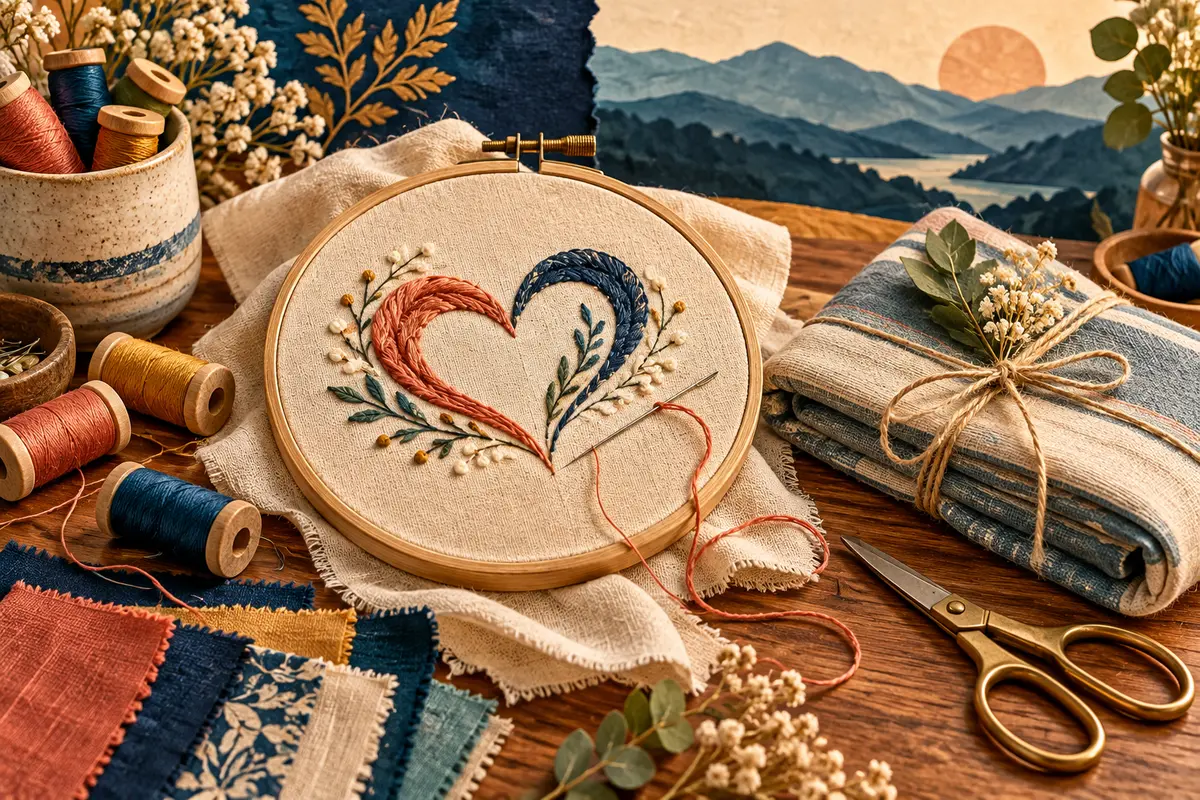
Custom work begins before the first stitch. A customer has to recognize what can be made, imagine it in their own colors or story, and understand how to begin. Heart’felt’ Travels in Dayton offers a useful lens on that challenge: how can a hands-on business make personal work feel specific without making the buying path feel complicated?
Independent community business spotlight. This article is independently researched editorial coverage, not a Build Brand Grow client case study or sponsored recommendation. We have not visited the shop, placed an order, or interviewed its owner. The artwork is an editorial illustration and does not depict the actual business, premises, people, or products.
A custom embroidery business with a Dayton storefront
Heart’felt’ Travels is a veteran-owned custom embroidery and handmade-gift business. Its official website describes pieces designed, stitched, and finished individually in Tennessee, with work ranging from personalized gifts to military keepsakes. The Dayton Chamber listing describes the company as female veteran-owned and places it at 1332 Market Street, Dayton, TN 37321. Rhea County Tourism lists the same storefront as 1332 South Market Street.
The move into a Tennessee storefront is recent. Rhea County Tourism’s event listing recorded a July 14 soft opening and an August 1, 2026 grand opening at that address. Those dates establish the local launch milestones; they do not tell us how every order works today. Customers should use the business’s current website or social Page for up-to-date ordering and visiting information.
The current website and linked online shop show an active business offering made-to-order embroidered apparel and customizable gift items. That combination—a physical storefront and online ordering—creates more ways to meet a customer, but it also creates more places where the business has to explain the work clearly.
When the product is custom, make the path concrete
“Custom embroidery” signals possibility. It can also create questions: What can be personalized? Which details can change? Where does a customer start? A strong explanation does not have to list every variation. It has to give enough examples for someone to recognize a fit and enough direction to take the next step.
Heart’felt’ Travels’ website does this by pairing a broad promise with specific examples. The featured work includes team-themed apparel, vintage-style crewnecks, and military-family designs. We are not evaluating the quality of those items or suggesting that the examples represent the complete catalog. Editorially, the useful choice is that the site lets a visitor see distinct use cases instead of asking them to interpret “we embroider almost anything” on its own.
For another custom business, the equivalent might be three representative projects: one straightforward order, one personal gift, and one more involved commission. Give each a plain-language description of what was customized. That helps a prospective customer form a better question before they contact you.
What three examples would help a first-time visitor understand the range of our work without making them read an entire catalog?
Make the process part of the proof
A finished custom piece shows the result. The process helps explain why the result is not interchangeable with something pulled from a shelf. The official site emphasizes that pieces are handled one at a time. Its gallery language focuses on what comes off the embroidery hoop, keeping attention on the making rather than on a generic claim about quality.
This does not prove turnaround times, durability, or customer satisfaction, and we are not assigning those outcomes to the business. It does illustrate a practical content idea: if your work is difficult to compare from a price list alone, show the decisions and labor a customer would otherwise miss.
A baker might show the sketch and icing plan behind a custom cake. A sign shop might explain material selection and installation preparation. A service business can do the same without a physical product by showing the checklist, review, or handoff behind the work. The purpose is not to make the process look complicated. It is to make the value understandable.
Organize the offer around customer occasions
Personalized work is often purchased for a moment: a team season, a family milestone, a service connection, a gift, or a group identity. Those occasions give a small business more useful language than a long list of equipment or techniques.
On its public pages, Heart’felt’ Travels connects embroidery to recognizable groups and occasions. That is an important distinction. “We own embroidery equipment” describes capacity. “We make a personalized item for this kind of moment” helps someone decide whether to keep looking.
Owners can test this on their own website. Write down the five most common reasons people contact you. Compare those reasons with the labels in your navigation, service pages, and social posts. If customers think in occasions but the website speaks only in technical categories, add a short bridge between the two.
A storefront adds another layer of trust
A local shop has to answer two types of questions at once: “Can you make this?” and “How do I work with you here?” An accurate address, current visiting details, ordering instructions, and a consistent name across the website and social profiles all help customers connect the online business with the physical place.
For Heart’felt’ Travels, the tourism and Chamber sources agree on the Dayton storefront, while the official website carries the current product presentation and shopping links. The official Facebook Page uses the same business identity and describes embroidery and hand-stitched items for gifting and special occasions. Together, those sources make the identity and operating business verifiable without requiring us to infer a firsthand experience.
For your own business, search your name the way a new customer would. Check the address, phone, hours, and next-step instructions on every result you control. If one detail changes, keep a small update list so the website, social profiles, directory listings, and printed materials do not drift apart.
Bring the lesson back to your business
Choose one custom or high-consideration service. Add three concrete examples, one sentence about what happens first, and one accurate contact path. Then ask someone unfamiliar with the service to explain what they could request and how they would begin.
Use our local brand trust checklist to review the rest of the customer experience. If the questions you receive keep repeating, turn them into useful material with our customer-question content guide. You can also read the previous Dayton business spotlight for a different look at how clear occasions and practical information support a local offer.
To see current products or contact information, visit Heart’felt’ Travels online or its official Facebook Page.
Business details checked October 2, 2026 against the official website, the business’s active online shop, the Dayton Chamber directory, and Rhea County Tourism’s opening record. The Facebook identity matches the indexed Dayton business name and current public product activity. Business-owner observations are Build Brand Grow’s editorial analysis; no customer result, order experience, turnaround time, product-quality assessment, or owner interview is implied.